
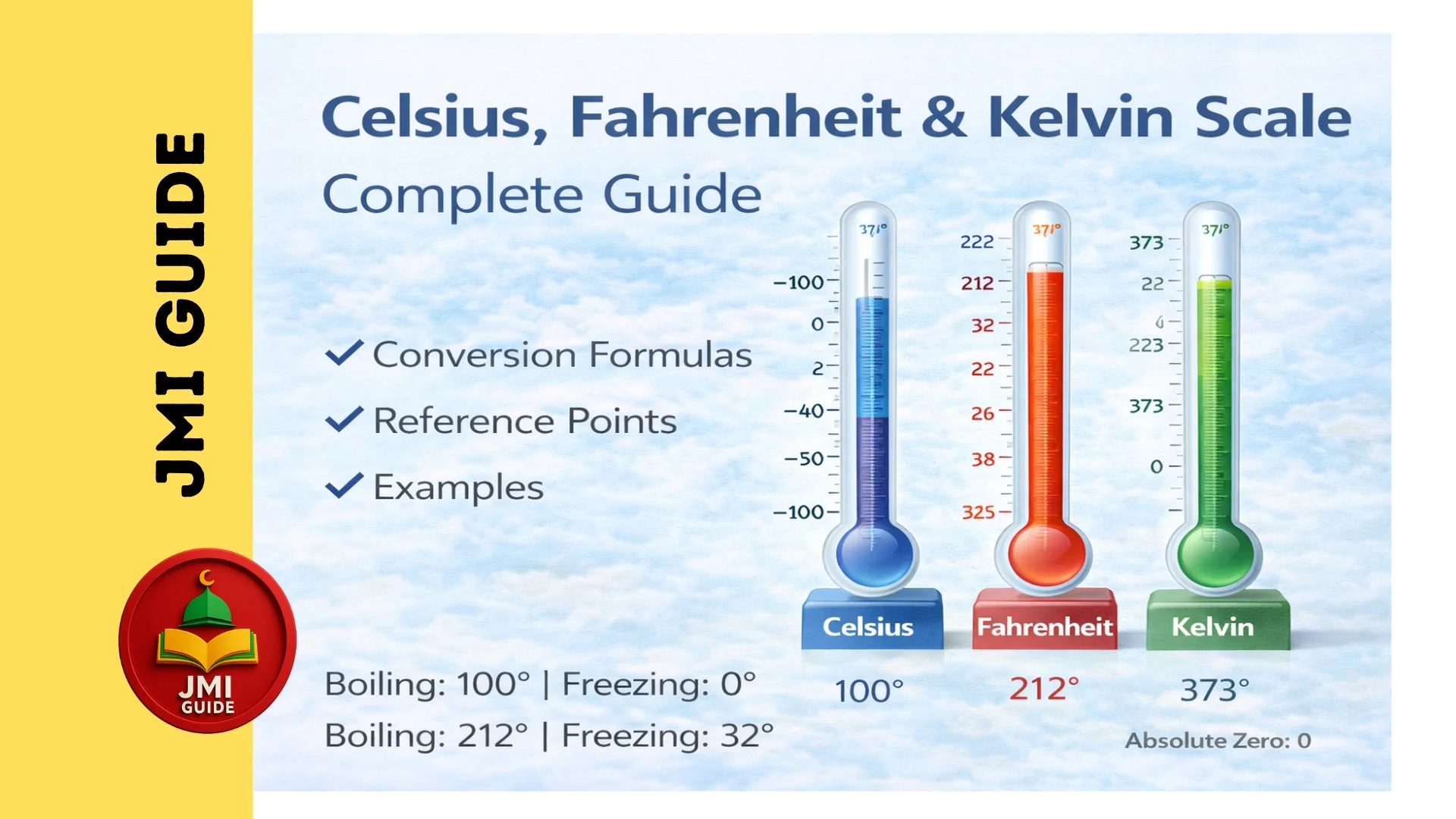
Confused between °C, °F, and K? This guide will help you understand the Celsius Fahrenheit Kelvin scale in a simple way—using a clean comparison table, all conversion formulas, and quick examples you can solve in seconds.
Quick Answer (Save This)
- 0°C = 32°F = 273.15 K
- 100°C = 212°F = 373.15 K
- Absolute zero = 0 K = −273.15°C = −459.67°F
If you remember just these three lines, you will solve most temperature questions easily.
Celsius Fahrenheit Kelvin scale: What’s the real difference?
All three scales measure the same thing—temperature—but they use different starting points and different numbering systems.
- Celsius (°C): Built around water’s freezing and boiling points.
- Fahrenheit (°F): Mostly used in the USA; different reference points.
- Kelvin (K): Used in science; starts at absolute zero (no negative Kelvin).
Comparison Table (Fast Understanding)
| Point / Feature | Celsius (°C) | Fahrenheit (°F) | Kelvin (K) |
|---|---|---|---|
| Freezing point of water | 0°C | 32°F | 273.15 K |
| Boiling point of water | 100°C | 212°F | 373.15 K |
| Absolute zero | −273.15°C | −459.67°F | 0 K |
| Common use | Weather + daily use | USA weather | Science/thermo |
| Degree sign | Yes | Yes | No |
Conversion Formulas (Celsius Fahrenheit Kelvin scale)
- Convert Celsius to Fahrenheit: °F = (°C × 9/5) + 32
- Convert Fahrenheit to Celsius: °C = (°F − 32) × 5/9
- Convert Celsius to Kelvin: K = °C + 273.15
- Convert Kelvin to Celsius: °C = K − 273.15
- Convert Fahrenheit to Kelvin: K = (°F − 32) × 5/9 + 273.15
- Convert Kelvin to Fahrenheit: °F = (K − 273.15) × 9/5 + 32

Examples (Step-by-Step)
Example 1: 25°C to °F
°F = (25 × 9/5) + 32 = (25 × 1.8) + 32 = 45 + 32 = 77°F
Example 2: 86°F to °C
°C = (86 − 32) × 5/9 = 54 × 5/9 = 30°C
Example 3: 30°C to K
K = 30 + 273.15 = 303.15 K
Example 4: 300 K to °C
°C = 300 − 273.15 = 26.85°C (≈ 27°C)
Example 5: 68°F to K
K = (68 − 32) × 5/9 + 273.15 = 36 × 5/9 + 273.15 = 20 + 273.15 = 293.15 K
Common Mistakes Students Make (Avoid These)
- Writing Kelvin as °K (Wrong). Correct is K.
- Mixing formulas (especially +32 part in °C ↔ °F).
- Forgetting 273.15 when converting °C ↔ K.
- Rounding too early in calculations (round at the end).
FAQs
1) Which scale is best for science—Celsius or Kelvin?
Kelvin is best for science because it starts from absolute zero and is the SI unit.
2) Why is 0°C equal to 32°F?
Because Celsius and Fahrenheit have different reference points and step sizes.
3) Can Kelvin be negative?
No. Kelvin starts at 0 K (absolute zero), so negative Kelvin is not used in basic science.
4) What is the easiest conversion to remember?
Celsius ↔ Kelvin: just add or subtract 273.15.
5) What are the most important values for exams?
0°C = 32°F = 273.15 K and 100°C = 212°F = 373.15 K.
Quick Tip (Increase your speed)
Bookmark this page or write these in your notebook:
0°C ↔ 32°F ↔ 273.15K and the 4 core formulas (C↔F, C↔K).