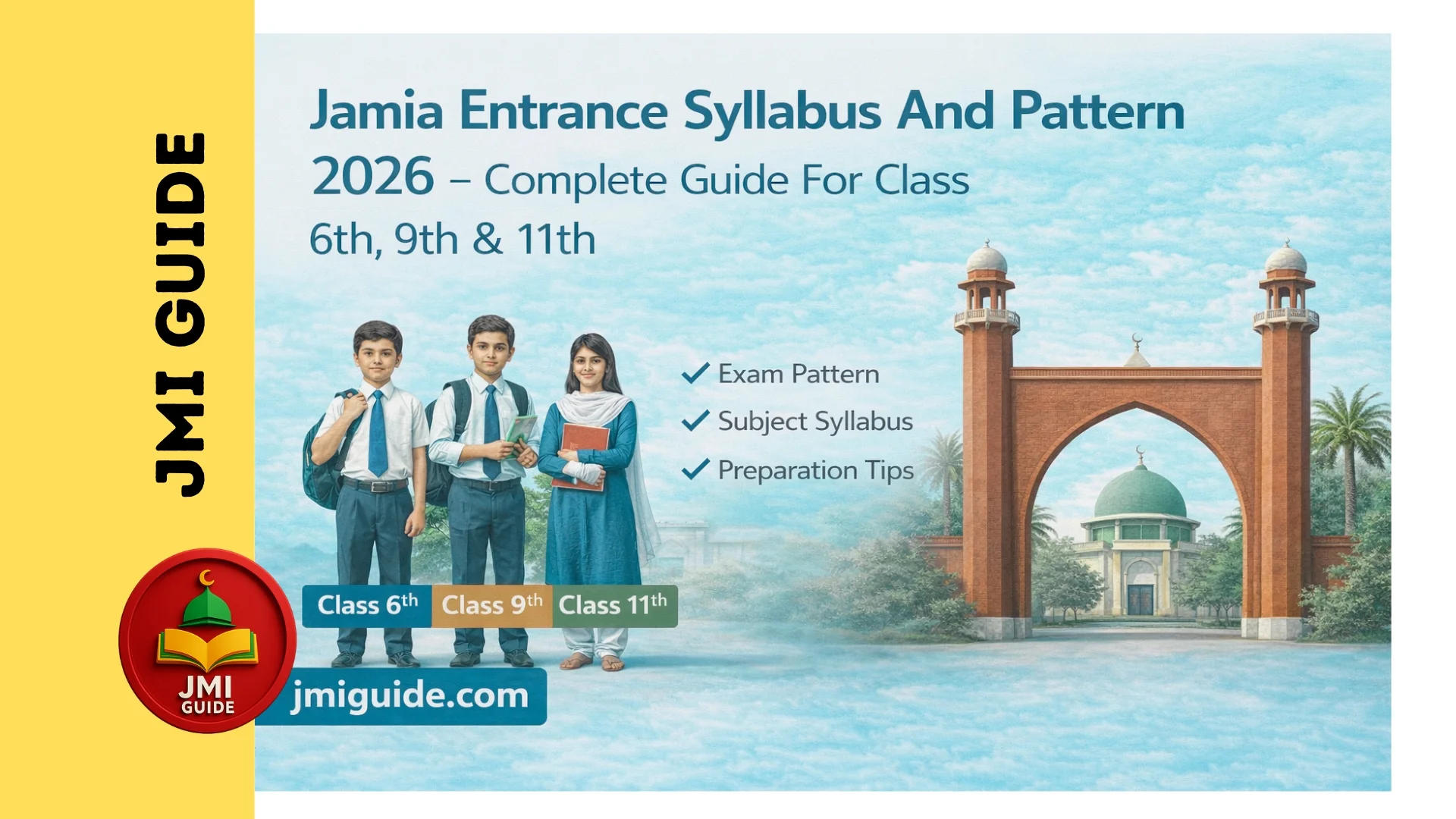
Jamia Entrance Syllabus and Pattern 2026 – Complete Guide for Class 6th, 9th & 11th
Jamia Millia Islamia (JMI) conducts school entrance exams for Class 6th, 9th, and 11th (Science, Commerce, Arts). If you’re preparing for any of these, understanding the Jamia Entrance Syllabus and Pattern is the first step to success.
Jamia School Entrance Syllabus and Pattern
Jamia Class 6th Entrance Exam Syllabus and Marking Scheme
| Subject | No. of Questions | Marks |
| English | 25 | Noun | Pronoun | Adjective | Verb | Adverb | Preposition | Conjunction | Interjunction | Singular & Plural | Gender | Articles | Auxiliary & Modal Verbs | Punctuation Marks | Prefix & Suffix | Kind of Sentences | WH Question Words | Silent letters | Pronunciation | Tenses — Present/Past/Future | Antonyms | Synonyms | Homophones | Spelling Test | Words Denoting Groups | Occupations | Active & Passive | Homes or Shelters | Young Ones |
| Mathematics | 25 | Roman Numerals Factors and Multiples Number Systems Simplifications Average Decimals Fractions Can You See the Patterns Measurement: Length, Mass and Capacity Money Time Temperature Basic Geometrical Concepts (Lines, Angles, Triangles, Circles & Quadrilaterals) How Many Squares Mensuration: Perimeter and Area Mensuration: Surface Area and Volume Simple Interest Profit and Loss Percentage Does It Look the Same Branch of Mathematics Boxes and Sketches |
| Environmental Studies (EVS) | 50 | Super Senses A Snake Charmer’s Story From Tasting to Digesting Mangoes Round the Year Seeds and Seeds Every Drop Counts Experiments with Water A Treat for Mosquitoes Up You Go! Walls Tell Stories Sunita in Space What If It Finishes…? A Shelter is so High! When the Earth Shook! Blow Hot, Blow Cold Who Will Do This Work? Across the Wall No Place for Us? A Seed Tells a Farmer’s Story Whose Forests? Like Father, Like Daughter On the Move Again |
| Total | 100 MCQs | 100 Marks |
Duration: 2 hour
Medium: English/Hindi/Urdu
Level: Based on NCERT Class 5 syllabus
Recommended Book:
- The Conceptum Class 6th Entrance Guide (NCERT-Based) – Includes chapter summaries, MCQs, and PYQs.
Jamia Class 9th Entrance Syllabus – Subject-wise Topics
| Subject | No. of Questions | Topics Covered (Based on NCERT Class 8) |
| Mathematics | 25 | Rational Numbers Linear Equations in One Variable Understanding Quadrilaterals Data Handling Squares and Square Roots Cubes and Cube Roots Comparing Quantities Algebraic Expressions and Identities Mensuration: Two Dimensional (2D) Shapes Mensuration: Three Dimensional (3D) Shapes Exponents and Powers Direct and Inverse Proportions Introduction to Graphs Playing with Numbers |
| Science | 25 | Crop Production and Management Microorganisms: Friend and Foe Coal and Petroleum Combustion and Flame Conservation of Plants and Animals Reproduction in Animals Reaching the Age of Adolescence Force and Pressure Friction Sound Chemical Effects of Electric Current Some Natural Phenomena Light Stars and the Solar System (Old NCERT) Materials: Metals and Non-Metals (Old NCERT) Cell: Structure and Functions (Old NCERT) Pollution of Air and Water (Old NCERT) Synthetic Fibres and Plastic (Old NCERT) |
| Social Science | 25 | OUR PASTS III (History) Introduction: How, When and Where From Trade to Territory: The Company Establishes Power Ruling the Countryside Tribals, Dikus, and the Vision of a Golden Age When People Revolt: 1857 and After Civilising the “Native,” Educating the Nation Women, Caste, and Reform The Making of the National Movement: 1870s–1947 India After Independence (Old NCERT) Weavers, Iron Smelters and Factory Owners (Old NCERT) Social and Political Life (Civics) The Indian Constitution Understanding Secularism Parliament and the Making of Laws Judiciary Understanding Marginalisation Confronting Marginalisation Public Facilities Law and Social Justice Understanding Our Criminal Justice System (Old NCERT) Resources and Development (Geography) Resources Land, Soil, Water, Natural Vegetation and Wildlife Resources Agriculture Industries Human Resources Mineral & Power Resources (Old NCERT) |
| English | 25 | Noun Pronoun Adjective Verb Adverb Preposition Conjunction Interjunction Word Transformation Singular and Plural Articles Types of Sentences Conditional Sentence Active & Passive (Voice) Direct and Indirect Speech (Narration) Antonyms Synonyms Spelling Test Tenses |
| Total | 100 | Class 8 NCERT-based |
📥 Download PDF Syllabus: (Provide a button here or link space)
🏆 Crack JMI Class 9 Entrance: Best Study Material
Jamia Class 11th Syllabus – Science, Commerce, Arts
1. Class 11th Science
| Subject | Chapters |
|---|---|
| PHYSICS – CLASS 9th | Measurement Motion Force and Laws of Motion Gravitation Work, Energy and Power Sound |
| PHYSICS – CLASS 10th | Reflection of Light Refraction of Light The Human Eye and Colourful World Electricity Magnetic Effect of Electric Current |
| CHEMISTRY – CLASS 9th | Matter in Our Surroundings Is Matter Around Us Pure? Atoms and Molecules Structure of Atoms |
| CHEMISTRY – CLASS 10th | Chemical Reactions and Equations Acids, Bases and Salts Metals and Non-metals Carbon and Its Compounds Periodic Classification of Elements (Old NCERT) |
| BIOLOGY – CLASS 9th | The Fundamental Unit of Life Tissues Diversity in Living Organisms (Old NCERT) Why Do We Fall Ill? (Old NCERT) Natural Resources (Old NCERT) Improvement in Food Resources |
| BIOLOGY – CLASS 10th | Life Processes Control and Co-ordination How Do Organisms Reproduce? Heredity and Evolution Our Environment Management of Natural Resources (Old NCERT) |
| MATHEMATICS | Number System Polynomials Linear Equations in Two Variables Quadratic Equations Co-ordinate Geometry Arithmetic Progressions Areas of Parallelograms Lines and Angles Circles Surface Areas and Volumes Trigonometry Triangles Areas Related to Circles Probability Statistics |
| Other Sections | English Aligarh Movement Indo-Islamic Culture General Knowledge Current Affairs |
2. Class 11th Commerce
| Subject | Chapters |
|---|---|
| Class 9th – History | 1. The French Revolution 2. Socialism in Europe and the Russian Revolution 3. Nazism and the Rise of Hitler 4. Forest Society and Colonialism 5. Pastoralists in The Modern World |
| Class 10th – History | 1. The Rise of Nationalism in Europe 2. Nationalism in India 3. The Making of a Global World 4. The Age of Industrialisation 5. Print Culture and the Modern World |
| Class 9th – Political Science | 1. What is Democracy? Why Democracy? 2. Constitutional Design 3. Electoral Politics 4. Working of Institutions 5. Democratic Rights |
| Class 10th – Political Science | Power Sharing Federalism Gender, Religion and Caste Political Parties Outcomes of Democracy |
| Class 9th — Geography | India – Size and Location Physical Features of India Drainage Climate Natural Vegetation and Wildlife Population |
| Class 10tth — Geography | Resources and Development Forest and Wildlife Resources Water Resources Agriculture Minerals and Energy Resources Manufacturing Industries Lifelines of the National Economy |
| Class 9th — Economics | The Story of Village Palampur People as Resource Poverty as Challenge Food Security in India |
| Class 10th — Economics | Development Sectors of the Indian Economy Money and Credit Globalisation and Indian Economy Consumer Rights |
| Mathematics | Number Systems Polynomials Linear Equations in Two Variables Quadratic Equations Coordinate Geometry Arithmetic Progressions Areas of Parallelograms and Triangles Lines and Angles Circles Surface Areas and Volumes Trigonometry Triangles Areas Related to Circles Probability Statistics |
| English | |
| Elementary Math | Squares and Square Roots Cubes and Cube Roots Exponents and Powers Rational Numbers Algebraic Expressions and Identities Linear Equation in One Variable Simple Interest Profit, Loss and Discount Percentage |
| General Knowledge | |
| Current Affairs |
3. Class 11th Arts
| Subject | Chapters |
|---|---|
| Class 9th – History | 1. The French Revolution 2. Socialism in Europe and the Russian Revolution 3. Nazism and the Rise of Hitler 4. Forest Society and Colonialism 5. Pastoralists in The Modern World |
| Class 10th – History | 1. The Rise of Nationalism in Europe 2. Nationalism in India 3. The Making of a Global World 4. The Age of Industrialisation 5. Print Culture and the Modern World |
| Class 9th – Political Science | 1. What is Democracy? Why Democracy? 2. Constitutional Design 3. Electoral Politics 4. Working of Institutions 5. Democratic Rights |
| Class 10th – Political Science | Power Sharing Federalism Gender, Religion and Caste Political Parties Outcomes of Democracy |
| Class 9th — Geography | India – Size and Location Physical Features of India Drainage Climate Natural Vegetation and Wildlife Population |
| Class 10tth — Geography | Resources and Development Forest and Wildlife Resources Water Resources Agriculture Minerals and Energy Resources Manufacturing Industries Lifelines of the National Economy |
| Class 9th — Economics | The Story of Village Palampur People as Resource Poverty as Challenge Food Security in India |
| Class 10th — Economics | Development Sectors of the Indian Economy Money and Credit Globalisation and Indian Economy Consumer Rights |
| English | |
| General Knowledge | |
| Current Affairs |
📘 Recommended Book:
🛒 Buy for Sure Success: JMI 11th Arts & Commerce
Jamia School Entrance Exam Pattern – All Classes
| Class | No. of Questions | Total Marks | Duration | Negative Marking |
| Class 6th | 100 | 100 | 2 hrs | No |
| Class 9th | 100 | 100 | 2 hrs | No |
| Class 11th | 100 | 100 | 2 hrs | No |
🎯 How to Prepare Effectively?
- Follow NCERT Textbooks of the previous class
- Solve PYQs – available in The Conceptum books
- Make short notes and revise regularly
- Practice time-based mock tests
Useful Links:
👉 Jamia School List with Seats & Cutoff
👉 Jamia Class 6th Entrance Guide
FAQs
- Which books are best for preparing Jamia Class 6th entrance syllabus and pattern? The Conceptum’s Class 6th Guide is highly recommended, covering syllabus, solved papers, and practice questions.
- What subjects are included in Jamia Class 9th entrance syllabus? The syllabus includes Science (33 marks), Mathematics (33 marks), and English (34 marks), aligned with NCERT Class 8.
- Is the Jamia Class 9th entrance exam pattern based on NCERT? Yes, the syllabus is based on NCERT, and the pattern includes subject-wise MCQs.
- Can I get a subject-wise PDF of the Jamia Class 9th syllabus? Yes, The Conceptum and JMIForm.com provide subject-wise syllabus PDFs.
- How much weightage is given to English in Jamia Class 9th entrance? English carries 34 marks in the entrance test for Class 9th.
- What is the exam pattern for Jamia Class 11th Science entrance? The Class 11th Science test includes questions from Physics, Chemistry, Biology/Maths, and General English, all from NCERT Class 10.
- Is the Jamia Class 11th entrance test conducted for all streams? Yes, separate papers are conducted for Science, Commerce, and Arts streams.
- What are the major topics for Jamia Class 11th Commerce entrance syllabus? Subjects include General English, Mathematics, Reasoning, and General Awareness.
- What type of questions are asked in the Jamia Arts stream entrance test? The Class 11th Arts test includes General Awareness, English, and Social Science-based questions.
- Are Jamia entrance exams objective or subjective? The entrance exams are objective type, consisting mostly of multiple-choice questions (MCQs).
- Does Jamia release official entrance syllabus for each class? Yes, Jamia officially releases the entrance syllabus and pattern in its school prospectus.
- What is the duration of Jamia school entrance tests? Typically, the test duration is 1 hour 30 minutes (90 minutes) for all classes.
- Are there any negative markings in Jamia school entrance exams? No, Jamia school entrance exams usually do not have negative marking.
- Can I apply for Jamia Class 9th and 11th together? No, you can apply for only one class per candidate as per eligibility.
- How do I prepare for the Jamia school entrance pattern? Focus on NCERT syllabus, attempt previous year papers, and use The Conceptum’s guidebooks.
- Where can I find previous year question papers for Jamia entrance tests? You can find them in The Conceptum’s Entrance Exam Books or download selected ones from jmiform.com.
- What is the eligibility age for appearing in Jamia entrance exams? Eligibility age is calculated as of 31 March of the admission year; it varies by class.
- Does the Jamia entrance syllabus and pattern change every year? Minor changes may happen, but the core pattern based on NCERT remains mostly consistent.
- Can CBSE or State Board students apply for Jamia school entrance? Yes, students from all boards can apply, but must prepare from NCERT books.
- What is the level of difficulty of the Jamia school entrance exams? The difficulty level is moderate, mostly NCERT-based but requires concept clarity and speed.
- Do Jamia school entrance exams include reasoning or aptitude questions? Yes, for Class 11th (especially Commerce), reasoning and aptitude are included.
- Are there any scholarships for Jamia school students? Yes, fee concessions and merit-cum-means scholarships are available post-admission.
- Can I take Jamia school entrance in Hindi medium? The medium is generally English, but some questions (especially in Class 6) may be bilingual.